Showing posts with label reviews: humor. Show all posts

Friday, July 21, 2023

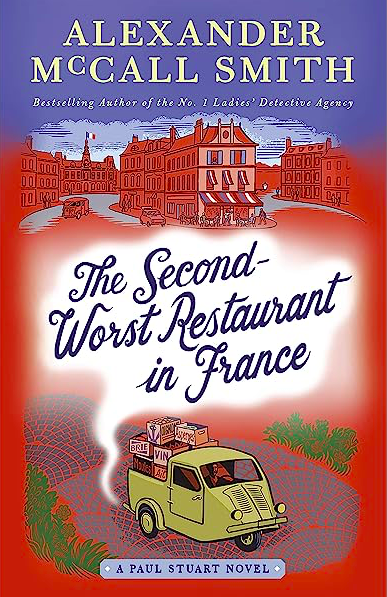
Reviews: "My Italian Bulldozer" and "The Second-Worst Restaurant in France," Alexander McCall Smith


Here’s the thing about Alexander McCall Smith. He’ll put two characters in a genteel, meandering conversation that is interesting, but not scintillating. The reader may wonder: Where is this going?


Then, a camper trailer burns down. An ex-girlfriend pitches a fit in the middle of a restaurant. A stranger places an olive seductively into the mouth of a man, and his partner arrives just in time to see it.


I love McCall Smith’s books because of their gentle stories, interesting characters and, yes, philosophical discussions. But I also appreciate the way he stresses that the sorrows and indignities of life are always part of the plot.


Food writer Paul Stuart is the protagonist in this two-part series. He’s a kind man who dislikes confrontation. Despite his unwillingness to grab life with two fists, good things come to Paul — eventually.


Take the matter of the bulldozer. Paul has left Edinburgh to research and write a book in Tuscany. A misunderstanding at a car rental agency lands him in jail. Luckily, because of the type of guy he is, Paul listened to his seatmate pontificate on the plane, instead of reading a book. This passenger is an Italian VIP who not only gets Paul out of his mess but arranges for him to get transportation to the village outside of Pisa, where he’ll be staying.


Unfortunately, the vehicle is a bulldozer.


Paul is naturally apprehensive about driving this huge beast of burden on any public roads, not to mention in a foreign country. He is also nervous because Italians have a reputation for being, let us say, emotional drivers.


But his new friend, the Professor, tells him, “Going off to Montalcino on a bulldozer may seem odd, even foolish, but it is not. It will get you there, and once there, it will take you to other places you wish to visit.” Metaphorically, he means. This is Italy, not Germany, as the Professor points out.


Indeed, Paul resolves the lingering issues dealing with a romantic breakup, writes his book and finds new love.


In the second book, Paul ends up in France because he can’t find the peace and quiet to write. His new girlfriend has two cats who drive him crazy. His eccentric cousin, Chloe, offers him an apartment she owns, but the students upstairs have a band and their practice sessions are intolerably loud.


Paul has a book, The Philosophy of Food, promised to his publishers, and it’s going very slowly. So he takes Chloe up on her offer to join her in a small village in France where, presumably, he will be able to get something done. There, he becomes involved in the life of the village, particularly La Table de St. Vincent, which has been dubbed by some locals as “the second worst restaurant in France.”


A case of food poisoning apparently caused by some bad mussels convinces Paul that the critics are right. He wants nothing to do with the place, but Chloe is determined to overhaul it. How can Paul, who is so involved with food and an excellent cook as well, refuse? He even becomes enthusiastic about the project when he realizes that Hugo, the chef’s nephew, is the true talent in the kitchen.


Together, Paul and Hugo create memorable meals that have the customers raving. And Paul finds a new topic to write about, one that truly excites him.


The Paul Stuart series is warm and engaging, and provides armchair travelers with pleasant explorations of Italy and France. What better way to spend a summer’s afternoon?


Thursday, May 21, 2015

Review: "Aunt Dimity and the Summer King," by Nancy Atherton

Lori Shepherd and her dear departed, but ever-accessible, Aunt Dimity are back to solve another mystery in the not-so-bucolic English village of Finch.

Lori, a Yank transplant who inherited her cozy cottage from Dimity, has welcomed baby Bess to her family, which includes her husband, Bill Willis, and twins Will and Rob. Lori is besotted with her infant, but also wants to take off the extra pounds she put on during pregnancy. As part of her exercise regimen, Lori packs Bess into her pram, and heads off down a lonely old farm lane.

The route seems to have gone unused for years, and is thoroughly rutted. As Lori pushes on, a wheel falls off the carriage.

Before she can panic, an elderly gentleman arrives on the scene. He has a kindly aspect, and is wearing a crown made of grapevines. He introduces himself as Arthur Hargreaves, or “the Summer King,”  as his grandchildren have dubbed him. His home, Hillfont Abbey, is nearby.

Lori is charmed by his manners and the efficient way he fixes the pram. But when she returns home and tells her story, she is met with shock and awe—even from Aunt Dimity. It seems the Hargreaves have been at the center of a feud between Finch and the adjoining village of Tillcote, a tiff that has lasted for generations.

Since Lori has never heard this story before, and she has a sense of curiosity that never knows when to quit, she is determined to suss out the root of the feud. Meanwhile, however, she is also perturbed by the fact that three cottages in the village are vacant. Is a developer about to swoop down on them and destroy the quaint Cotswold village?

One of the cottages — “Pussywillows” — belongs to Amelia Thistle,who is set to marry Bill’s father. In town to celebrate are Willis Sr.’s harpy sisters, Charlotte and Honoria, who are intent on making life miserable for everyone but their brother.

Lori confides in Dimity, who communicates with her through a journal. Dimity’s questions and advice steer Lori in the right direction. All comes to a happy end — even the evil sisters get their comeuppance.

Atherton’s series -- this is the 21st installment -- strikes just the right note for cozy readers. Lori is feisty and often foolish. Although the crimes are gentle, they are suspenseful. Finch is not a perfect village, and has its fair share of unpleasant, annoying characters.

But readers can sink into the milieu that includes Lori’s honey-colored cottage, Stanley the cat, and Sally Cook’s tearoom, and that makes each visit to Finch a joy, and each adventure with Aunt Dimity a satisfying one.


Friday, August 8, 2014

Review: "Miss Julia Stirs Up Trouble," by Ann B. Ross

Now that I’ve enjoyed Julia Murdoch’s latest adventure, I’m going to have to go back to the beginning of the series and start reading. It didn’t matter that I came to the town of Abbotsville, N.C., in Ann B. Ross’s 14th novel featuring the redoubtable “steel magnolia.” I quickly caught up with the salient facts and dove into the story with relish. Sorry, but there’s a smorgasbord of food in this book.

As the cover says, it features “dozens of recipes from Abbotsville’s best cooks.” Emma Sue contributes her “good beef stew recipe,” while Binkie offers a “fresh peach cobbler.” Anybody up for a hot plate of “company grits?”

These recipes were collected by Miss Julia herself. Her neighbor, the hapless Hazel Marie, has her hands full (literally and figuratively) taking care of her twin baby girls. Then Hazel Marie’s housekeeper, James, falls and is put out of commission. Her husband, Mr. J. D. Pickens, is a private detective who’s often on the road. When Miss Julia hears of the situation, she immediately springs into action.

Since Miss Julia rarely dirties a pan herself (her cook, Lillian, is a gem), she devises an interesting plan. She invites a half dozen of her friends and associates to contribute recipes to a book that she’ll eventually present to Hazel Marie. Miss Julia also asks each of her pals to show Hazel Marie how to prepare a dish. This ensures that the Pickens’ household will have edible dinners at least some of the time.

The scheme sounds foolproof, but then Hazel Marie’s conniving uncle, the proselytizing Brother Vern, arrives on the scene. He’s ailing, and has many demands that must be met. It’s all Miss Julia can do not to punch him in the puss, but she’s too much of a Southern belle to do that. She’s also worried about J.D., who has been seen around town in the company of unfamiliar women with big hair. Miss Julia is determined to find out what his game is, and the investigation leads straight into a riotous scene in a soup kitchen.

Then there’s Lloyd, the son of Hazel Marie and Wesley Lloyd Springer, Miss Julia’s first husband. Springer was a community icon, but after he dies, Miss Julia discovers he had a secret life. And a secret son. When Hazel Marie and Lloyd showed up on her doorstep years ago, she took them in. Life has not been the same since.

Between squalling babies, kitchen mishaps, and the specter of Brother Vern praising the Lord, Miss Julia barely has a chance to enjoy her newly renovated home and her newish husband, Sam. Readers, however, have the chance to sit back and smile and watch the fun. 

Thursday, May 15, 2014

Review: "Aunt Dimity and the Wishing " by Nancy Atherton

Why haven’t I visited the delightful Cotswold village of Finch until now?

Nancy Atherton’s 19th Aunt Dimity novel is a fun romp through one of my favorite regions of the world. I just can’t imagine why I, an avid mystery reader since age 9 (Nancy Drew), have overlooked this series.

In Aunt Dimity and the Wishing Well, I met Lori Shepherd, the narrator, her husband, Bill Willis, and their twin sons, Will and Rob. The couple are Americans who have settled in the gorgeous area that extends through several counties in south-central England. The Cotswolds is noted for the warm, golden stone that has been used to construct many of its buildings. Narrow roads weave through charming villages and past stately homes. I remember with fondness a cream tea I enjoyed on one sunny autumn day in the Cotswolds.

The residents of Finch are having a more typical English day as the book opens—it is raining. Most of them are attending the funeral of Hector Huggins, a villager who, as the Brits themselves would say, “kept himself to himself.” He had no close friends or, as far as anyone knew, any relatives.

But before the service is over, Jack MacBride, a handsome, cheerful Aussie, arrives and announces that he is Hector’s nephew. Jack has come to Finch to put his uncle’s estate into order.

The women of Finch are agog. Jack is a an affable hunk. Perhaps even more importantly, they will have a chance to finally see inside Ivy Cottage, Hector’s home. It is protected by an iron gate, and he never invited anyone in.

Lori, who loves to be in the know about everything that happens in the village, offers to help Jack clean out his uncle’s possessions and garden. She brings along Bree Pym, a native New Zealander. Bree has a Kiwi’s distrust of the man from Oz, but he’s impossible to dislike. His use of Australian slang is a delight: “Aldous Winterbottom tells me the electric’s still on and the phone’s still on, so I should be snug as a tick on a sheep’s backside.”

As the three take a look around the garden, they discover an old well. They clear away the weeds to find a plaque affixed to it: “Speak and Your Wish Shall be Granted.”

The trio is delighted, and, for fun, Lori shouts into the well, “Make it stop raining.”

The next day, the sun comes out.

Word of the wishing well spreads quickly through the village, and soon the overgrown path to the magic spot is flattened down. Some villagers sneak in at night. Jack can’t stop the influx, because wishes are coming true!

Elspeth Binney’s niece gets a commission to photograph the village for an upcoming book on the Cotswolds. Mr. Barlow gets to work on a Jaguar XE. Teashop owner Sally Pyne is visited by a cooking magazine editor, who promises to put her on the cover of his magazine.

It’s not long, though, before one villager’s wish becomes another’s curse. What will the farmers do without rain? Peggy Taxman surely can’t be outdone by her baker tenant. Lori hurts herself because Mr. Barlow is too busy fixing luxury cars to complete the carpentry work he promised to do.

Besides, no one really believes in magic. Who’s working the strings behind the screen?

The villagers’ frustrations come to a head in a riotous fight between Peggy and Sally. But with Aunt Dimity’s help, the truth behind the magic well is revealed.

And just who is Aunt Dimity? She’s a family friend who left Lori a fortune, a cottage and a blank journal. Through this little blue book, the wise and redoubtable Dimity advises Lori, and lets her reflect upon her concerns.

There’s nothing like a cozy village mystery to brighten a dreary day, especially one set in the golden lanes of the Cotswolds. I’m glad to have found a new favorite. Now, I’m off to read number one in the series, Aunt Dimity’s Death. I’ve got some catching up to do.